Searching for a specific blog post? Try here:

Moussaka

Justina made this amazing Moussaka from some ground mutton from one of our retired ewes and eggplant we got in our CSA share from local Milky Fork Farm.
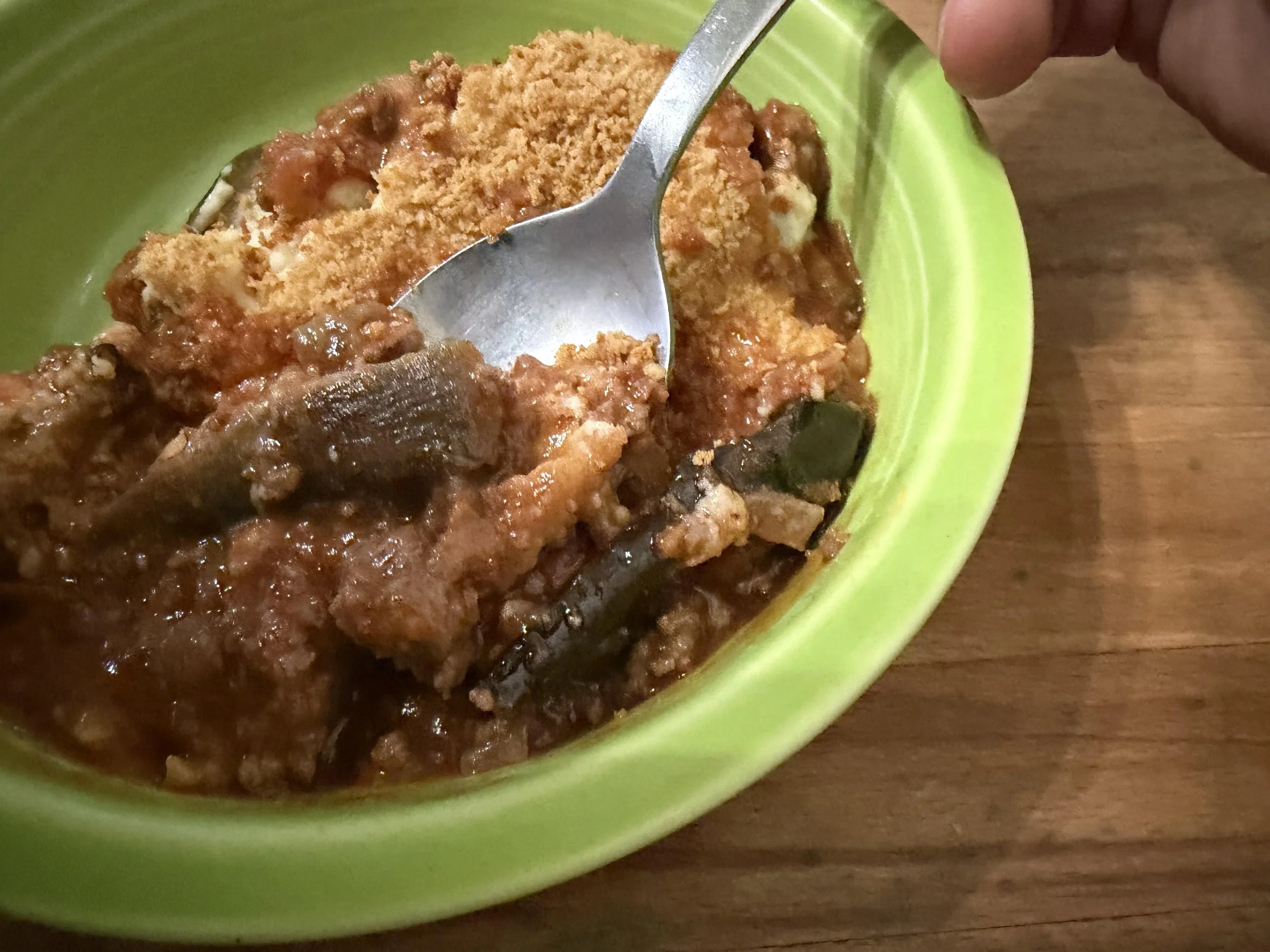
I actually have some relatives with Greek ancestry but I’ve never had a moussaka this good. Fresh and local ingredients make the dish, sometimes. Of note; we often have mutton instead of lamb, because when we are forced to retire an elderly ewe, I don’t feel justified in selling the meat at the same price for which we sell our grass fed lamb. It’s usually more economical to keep the mutton for ourselves. However, based on what I have researched, people from a couple hundred years ago who ate more lamb and mutton than Americans do today would think that people who eat lamb (a sheep less than one year old) are getting ripped off. After all, the flavor develops more as the animal ages, plus the roasts and chops get bigger. I’ve seen records of people from the 1800s asking for mutton from a 5-year-old sheep, which they considered the best. (Sheep can live for much longer than 5 years, but after that they start getting actually old and losing condition…kind of like I am.) They thought lamb didn’t have enough flavor and was something you ate because you couldn’t afford to feed your animals through the winter. I don’t know when we’ll next have mutton available to buy, but I can say that the coyotes really are mutton connoisseurs.

I don’t have a recipe for this moussaka because all I did was assemble it and put it in the oven, but this ain’t rocket science, it’s a cooking with love thing.

You need a cooking pot and some kind of high-sided skillet like a cast iron skillet, and preferably a whisk or at least a large spoon and an arm that is not tired yet.

You also need several eggplants, some ground meat (preferably mutton), crushed tomatoes, onion, garlic — look, just whatever you want for making a thick and tasty tomato/meat sauce.

Step 1: Slice the eggplant lengthwise (about 1/4 inch slices), salt it, and let it sit 30 minutes or so. Pat off any moisture that comes out (this also pats off some of the salt, which is fine.) Roast it in the oven — not so much that it’s mushy, but enough that it’s soft.

Step 2: Make a tomato meat sauce. You want it thick, so don’t add too much liquid and you’ll want to simmer it for a while to cook off the liquid you do add. If you don’t know how to make a tomato meat sauce, that’s totally fine, you’re already using the Internet so you should have no problem finding several thousand recipes. For this dish, since some people can find eggplant a little bitter, making a sauce on the sweeter side might help. Consider adding some cinnamon and a little brown sugar to your ground mutton tomato meat sauce.

Step 3: Make a bechamel sauce and add in parmesan and some nutmeg.

IF YOU DON”T KNOW HOW TO MAKE A BECHAMEL do not worry, it’s easy. Unlike tomato meat sauces for which there are thousands of recipes and I am not going to tell you your Nonna’s is not the best, anyone can make a standard bechamel.

Just put, like, 4 tablespoons of butter in a saucepan or something that has room for whisking several cups of liquid. Melt the butter over medium heat. When it’s melted sprinkle flour over it. Usually you’re supposed to use 1:1 butter to flour, but really, you can just sprinkle enough flour that you don’t have liquid butter anymore. You want all the butter soaked up by the flour. Now stir this for a few minutes while it cooks. But don’t burn it.

While whisking, add in about 2 1/2 cups of real, whole, preferably raw and unpasteurized milk (if you used 4 tablespoons of butter. If you used more or less butter and flour, just do the math.)

You should use raw milk if possible because it’s cleaner and healthier. After all, pasteurized milk has feces in it. You knew that, right? That’s what they’re pasteurizing. I mean, it’s pasteurized, so they’re “safe” feces. You won’t get sick or anything. On the other hand, small raw-milk dairy farmers have to be extremely careful to make sure there are absolutely no feces in your milk. So you can use poop milk if you want, but I prefer raw milk.

After adding the milk to the butter/ flour mix, whisk it a bunch and cook until it thickens. You’re looking for turkey gravy thickness.

Now remove your bechamel sauce from the heat, and whisk in any seasonings like salt, pepper, nutmeg. Add in grated parmesan and put the sauce back over low heat if you need to melt the grated parmesan.

You can find recipes that tell you how much grated parmesan to melt into the bechamel sauce, but whatever they said, it’s not enough.

Step 4: Assemble

Put slices of roasted eggplant to line the bottom of a reasonably-sized dish. A cast-iron skillet works great.

Now ladle in the meat/tomato sauce.

Top with more roasted eggplant. (It looks kind of like a meat pie with an eggplant crust.)

Pour the bechamel sauce over everything.

Top with panko (or homemade) breadcrumbs.

Bake in the oven at 350 F for 35-40 minutes (don’t let the breadcrumbs burn.) You should always cook using a Fahrenheit temperature scale, which is the best temperature measurement for things humans actually do regularly. Centigrade is objectively worse unless you need a thermometer to tell you if water is frozen or boiling.

Let the dish cool and set for 10-15 minutes before serving.

Modified Mutton "Biryani"

This is a sort-of approximation of a real biryani which is modified for cooks who are lazy time sensitive and who don’t necessarily have all of the ingredients on hand for a traditional biryani.

What is “Mutton”?

While the definitions change depending on where you are, in general “mutton” refers to meat from a sheep that is 2 years of age or older, meaning it has gone through at least one breeding cycle. “Lamb” is generally from a sheep that is around a year old or younger, and does not yet have its permanent incisors. The term for a sheep that is mature but between 1 and 2 years of age (and thus has likely not been through a breeding cycle) is a “hogget”. There is a very wide variation in grass-fed lamb or mutton, based on whether the animal was standing in lush pastures eating a salad bar of grasses and hay, or whether it was walking miles each day over scrub land looking for grass to eat. Neither of these methods of raising sheep is “better”, but if you’ve only tried range-raised lamb (or mutton) and it wasn’t to your taste, try some lamb from a local farmer who sees the animals every day instead of turning them loose on open range for the season.

Source: Anchor Ranch Farm

Materials

2 pounds of boneless mutton stew meat

2 cups of basmati rice

2-4 yellow or sweet onions (depending on size), sliced thin

plain yogurt, or milk

lemon juice

powdered or fresh ginger

minced garlic or garlic powder (not salt!)

butter

Ghee or lard (real lard, not the packaged stuff full of preservatives)

fresh cilantro, chopped

spices: salt, black pepper, nutmeg, mace (or more nutmeg), dried or fresh mint, cinnamon (stick and ground), cloves (whole), cardamom (pod or ground), ground cumin, ground coriander, bay leaves, turmeric.

You need the salt, nutmeg, cardamom of some form, and cinnamon. Cloves are a nice to have. For the rest, if you have to you could substitute a basic curry powder. Make sure your curry powder is salt-free or make sure you balance the curry and any extra salt you add. If you happen to have garam masala, use that.

A big heavy pot with a lid

Aluminum foil

Another pot

Optional: dried raisins or craisins, nuts, prunes, something like that

Method

Marinade the Mutton

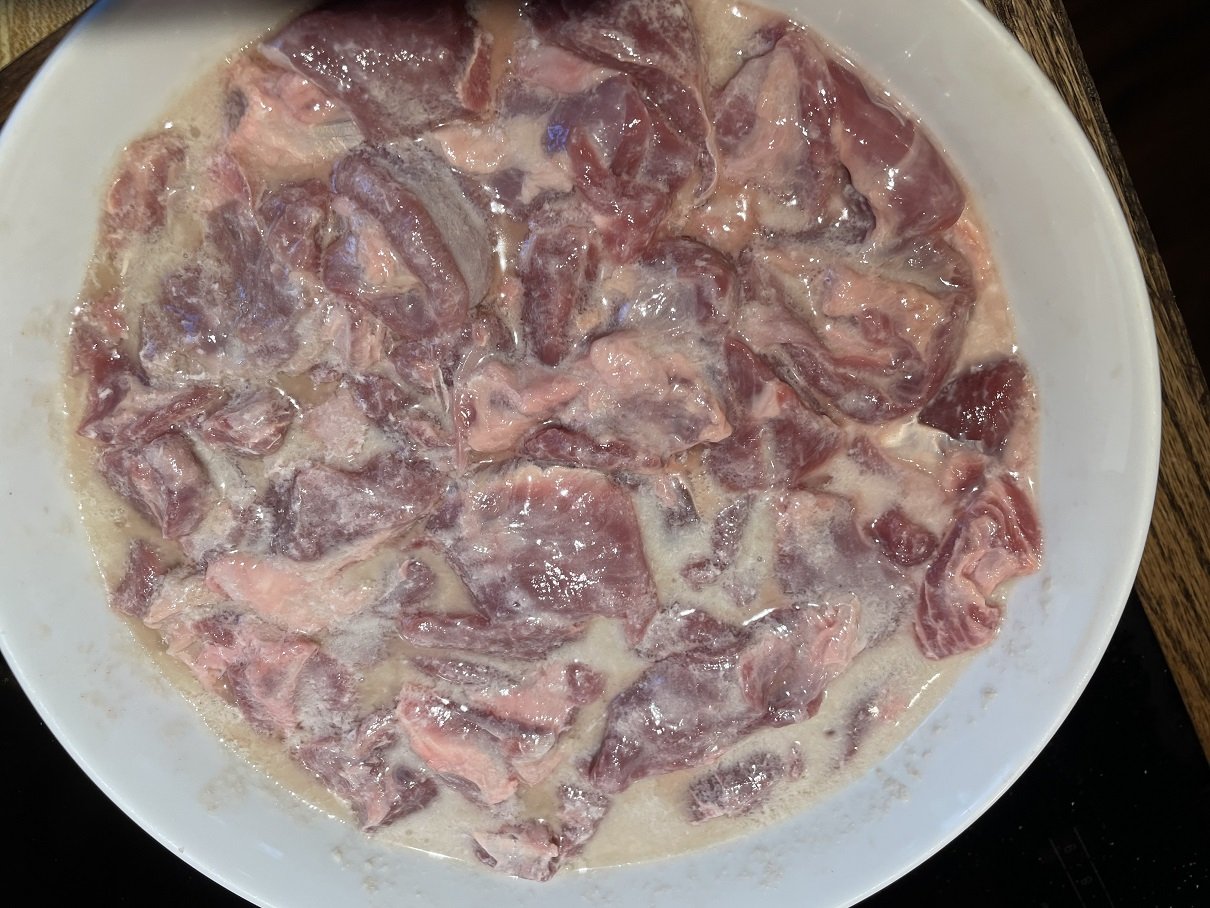
First, marinate the mutton in plain yogurt mixed with ginger and garlic powder for a few hours, or overnight if you can. If you don’t have plain yogurt, make a mix of milk (we always use local raw milk), a couple tablespoons of lemon juice, some salt, and powdered ginger and garlic, just enough to cover all of the mutton. You could grate fresh ginger instead of the powder, if you have it, and you could use minced fresh or dried garlic. Here is a photo of the mutton in the marinade:

Carmelize the Onions

Put some lard (or ghee) in the bottom of your big heavy pot and put it on medium heat. Add salt and the sliced onion and carmelize, stirring occasionally. How much salt depends on what you want it to taste like. The browner the onions get, the more flavor they will have, but the closer you get to burning them. If you have other things to do besides watch onions cook, just go until they have some brown bits in them, like the photo below.

Once the onions are sufficiently carmelized, add one cinnamon stick, a few cloves, dried or fresh mint (if you have it), 3-5 cardamom pods or a few pinches of ground cardamom, 2-3 bay leaves (if you have them), a few pinches of mace (if you have it, otherwise use extra nutmeg), and either a garam masala mix OR about half a nutmeg (ground), ground black pepper, several shakes of ground cumin and of ground coriander, and several shakes of cinnamon. If you want, add a bit of chili powder. Turn up the heat and cook and stir the onions with the spices for about another minute. The most important flavors here are the carmelized onion, the cardamom, nutmeg or mace, cumin, coriander, cinnamon, and cloves. I don’t like giving spice measurements because it depends on how strong you like the flavors and how old your spices are. Try roughly equal parts cumin and coriander, slightly more than that of cinnamon, even more than that of cardamom, and a whole heck of a lot of nutmeg, maybe 50:50 with mace if you have it. As mentioned, you could substitute out some of these for a curry powder mix if that is all you have, just read the ingredients.

Simmer the Mutton Until Tender

Add in the mutton along with its marinade. Add chopped cilantro, or parsley if you don’t like cilantro, or some other green herb that reminds you of cilantro or parsley (we used papalo). Stir everything to combine. Add about 2 cups of water and bring to a boil. Add extra salt to taste. I like to add chicken bouillon, not really for the weird stuff and the chicken flavor but for the MSG. I know, OMG, I thought you were about natural food, MSG is extracted from….seaweed, and L-glutamic acid is in a whole bunch of different kinds of natural foods. Hey, you do you, leave it out if you don’t like it. If you cooked the onions in lard and not ghee, consider adding a couple tablespoons of butter, for flavor. If you cooked the onions in some kind of hydrogenated vegetable oil, pack up your backpack and go to the principal’s office right now.

Turn the heat down, put the lid on, and simmer the mutton for several hours, stirring occasionally until it is tender. The cooking liquid should be bubbling but not popping boiling hot bubbles in your face. When done, you should be able to cut a piece of mutton in half with a wooden spatula. If the meat is not that tender, keep cooking, and add more liquid if necessary.

Prep the Rice

Meanwhile, rinse your rice (most rice has arsenic in it — which is probably not a big deal if you have a healthy immune system and you rinse it), then soak the rice in a pot of water, at least twice as much water as rice. (You can change out the water before cooking if you’re that kind of person.) When the mutton is close to tender, add to the rice pot a few tablespoons of butter, a pinch of salt (if to your taste), a jigger of lemon juice, some extra cardamom (pods or ground), and a healthy dose of turmeric. You can do without the turmeric if you want, it’s mostly to color the rice yellow, because saffron is really, really, really expensive. Bring the rice mixture to a rolling boil for just 2 minutes. Drain the rice (a mesh strainer is helpful but not strictly necessary.) Yes, you are wasting most of the flavorings since you only boiled the rice for 2 minutes. You could save the liquid and use it later as a base to cook another batch of rice.

Finish the Mutton, Steam the Rice

Take the lid off the mutton and crank up the heat, stirring while you reduce the cooking liquid until it’s still there but you can see the mutton above the top of the liquid. It’s better to err on the side of a little extra broth so you make sure there is enough liquid to finish steaming the rice. Then reduce the heat to low. Spread the parboiled rice evenly over the top of the mutton. Decorate (optionally) by sprinkling something like dried cranberries over the top.

Cover the cooking pot tightly. One way to do this is to seal it with aluminum foil and then put the lid on top of that. Steam the rice like this for around 30 minutes before checking to see if the rice is done.

Make a Raita

When the rice is steamed the biryani is done. It is best served with some kind of a raita, such as plain yogurt mixed with minced cucumber and chopped, fresh mint. By which I mean, ignore complicated raita recipes and chop up half a cucumber and a handful of mint, then mix it into a cup or so of plain yogurt.

Remember to take out the bay leaves and whole spices or at least warn people to watch out for them. Or don’t.

Source: Anchor Ranch Farm