Searching for a specific blog post? Try here:

Slow cooking meat outdoors (barbecue/smoking without a smoker)

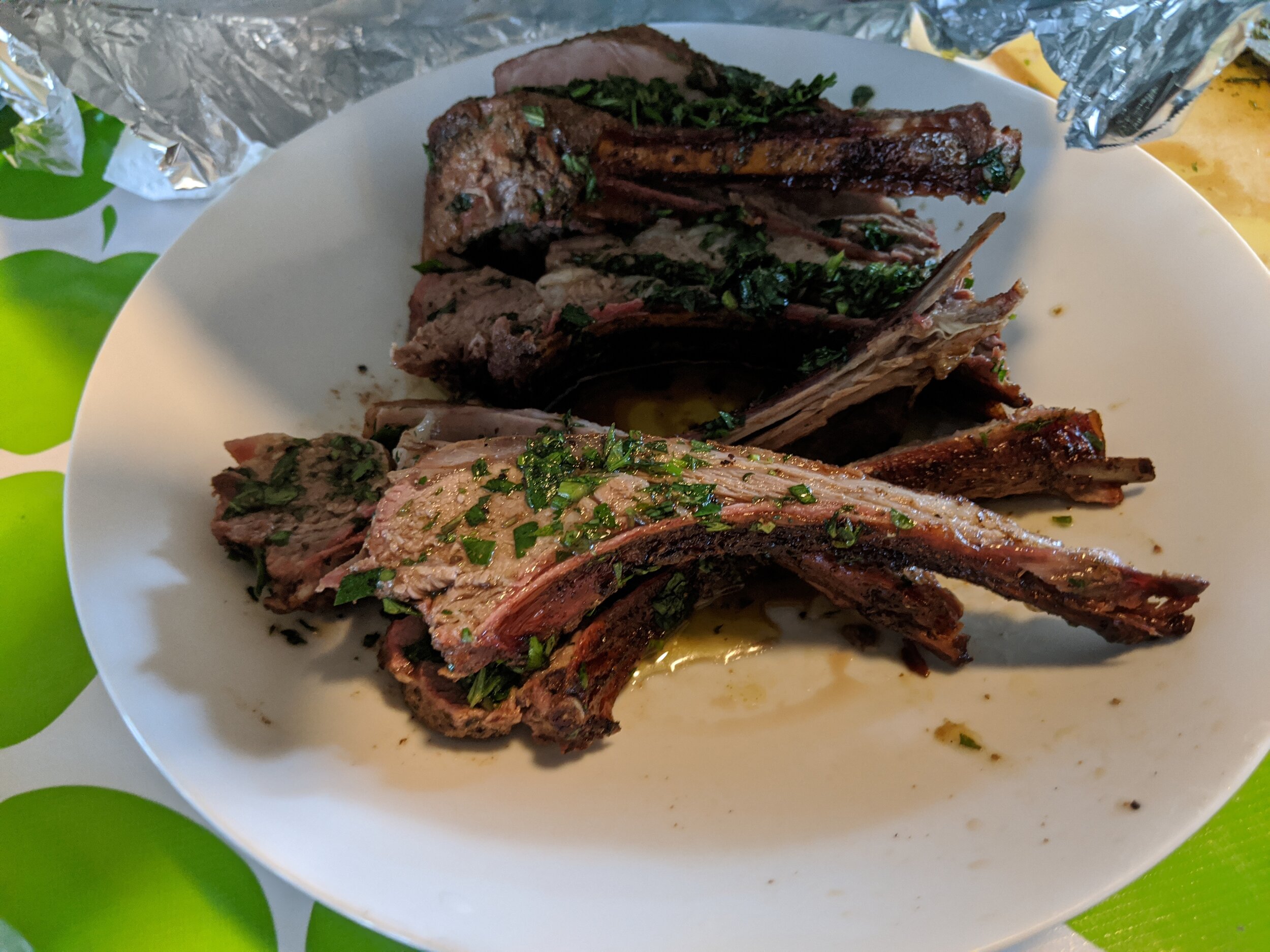
IMG_20200412_172037.jpg

Cooking with Convection

We use a Pit Barrel Cooker. We don’t know them or have any kind of business relationship with them, it just works really well. Of course, if you have the time and materials, you could make a barrel cooker yourself.

Alternatively, you can set up a charcoal grill for indirect heat. The kettle-style grills are best for this,

but you can do it with pretty much any style of charcoal grill. That’s the way we did it for years. It takes a little more work and isn’t as easy and fool proof, but you can do it!

  1. You’re going to want to use charcoal briquettes. It’s going to be very difficult (impossible) to set up a regular grill for barbecue/smoking while using lump charcoal.

  2. The Snake/Ouroboros. Around the inside perimeter of the grill make a line of briquettes just touching each other. This is why you have to use briquettes, so they are uniform size. You’re going to light these in one spot and then let the flame slowly travel around the circle. With only a few coals lit at a time, you’ll get an approximation of constant, low heat.

  3. Put a pan of water in the middle of the “snake”. This will act as a heat sink to further ensure a relatively constant heating temperature.

  4. Put your meat on the cooking grill directly in the middle of your briquette snake. Ideally it won’t also be above your pan of water — the aerosolized drippings hitting the hot metal of your grill help provide flavor — but if you have to, it’s not the end of the world.

  5. Adjust your vents so that the air (and thus smoke) flows across your meat. Remember hot air rises. If you just have a top and bottom vent, close up the top vent and barely prop open one side of the grill. Air will come up through the bottom vent, but the smoke will be unable to go out the top, so the smoke will surround your piece of meat until it finally leaks out the side of the grill. Keep in mind that air => fire so if your coals are burning too hot, close your intake vent (on the bottom) a bit more! (If your grill doesn’t have adjustable air vents you should throw it out.)

  6. You can add flavor with wood chips. Soak chips of some suitable wood. such as a fruit wood, in water, then make a little foil boat and send your wood chips to Valhalla in the fiery blaze. This prevents them from burning up right away, so you get the benefit of the wood smoke longer. You’ll want to do this at the beginning of the cook, as that’s when the most smoke flavor will penetrate the meat. You can also smoke with flavors besides wood, such as tea or dried herbs.

  7. Get a probe thermometer. For pulled pork you want to slowly bring the internal temperature of the roast to around 195 to 205 degrees F. Other kinds of meat require a different temperature.

  8. “Barbecue” is slow cooking until the meat is pull-apart-tender. “Grilling” is for small pieces of meat on skewers, or fish, or vegetables. Grilling large cuts of meat just dries them out. Steakhouses never grill their meat. You should stop too.

Finishing in the oven is okay

Slow-barbecue-smoking a large piece of meat on a charcoal grill can pose a lot of problems, but as long as you keep the heat low and adjust the ventilation properly, none of these problems really matter. Do not let perfect become the enemy of the good. It’s possible that your coals will go out before the meat is done. Another frequent problem is “stall”: after a few hours the meat gets to within 20 or 30 degrees of being fall-apart-tender done, and then the temperature increase stalls (because thermodynamics). If you encounter these or any other problems, just remove the meat from the grill, wrap it in foil, and finish it in the oven. The first few hours are the most important, because that’s when most of your smoky barbecue flavor is able to penetrate the meat. Finishing it in the oven after a few hours smoking on the grill will be almost as good as keeping it in the smoker the whole time. The key is to not rush. Keep the heat low, in the range of 225F or so.
The Precautionary Principle with Application to GMOs

For those who enjoy a bit of doom and gloom statistics, here is a link to the white paper by Taleb, et. al. describing the statistical risk involved in widespread use of GMO foods. This is pretty much the reasoning we follow in choosing not to feed our animals GMO grain. It’s also why, although we tend to prefer heirloom varieties, we don’t think you’re a horrible person if you buy, say, GMO tomatoes or something like that.

This argument against GMO foods is not the standard anti-GMO argument that we often hear from sensational media outlets or self-interested manufacturers of non-GMO foods; for one thing, this argument is entirely indifferent to whether GMO foods are healthy or not. In addition, the paper makes it clear that a lot of the applications of “the precautionary principle” that we see raised in shock media are spurious. It’s an interesting read.

We made a couple videos a while back explaining why we don’t use GMO feed:

We're in favor of scientific research and engineered solutions to problems. However, there is a risk of catastrophic food system collapse from genetically mo...
A quick version of the mathematical argument. If every time you do something there is an extremely small chance that it will result in catastrophe, and you d...


Local food systems vs. global collapse - also new lambs

Twin lambs born just a few hours before I made the video. Many people are right now enacting some version of "stay at home" in order to mitigate the systemic...

Twin lambs born just a few hours before I made the video.

Many people are right now enacting some version of "stay at home" in order to mitigate the systemic risk from covid-19. In this era of just-in-time transnational movement and trade, something like a severe pandemic, or worse, is almost certainly going to occur. This is not pessimism but simply an observation on the nature and fragility of complex network systems. Global food supplies are at risk.

An alternative is to make the choice to shop with local farms and, to the extent you can, grow your own food. Local farms with local supply chains are insulated from some systemic risks. Simplifying the supply chain now means peace of mind and a relative degree of comfort when the next blow to global supply chains inevitably occurs.

"Collapse now and avoid the rush," by John Michael Greer: https://www.resilience.org/stories/2012-06-06/collapse-now-and-avoid-rush/

Wikipedia entry on Joseph Tainter: https://en.wikipedia.org/wiki/Joseph_Tainter

Our long video on how to eat better food on a budget: https://youtu.be/RpPtFc0Gtm4

At Anchor Ranch Farm in beautiful Scio, Oregon we raise healthy, happy livestock outdoors on pasture. Visit us at anchorranchfarm.com to find out more.

Boiled Meat Dinner

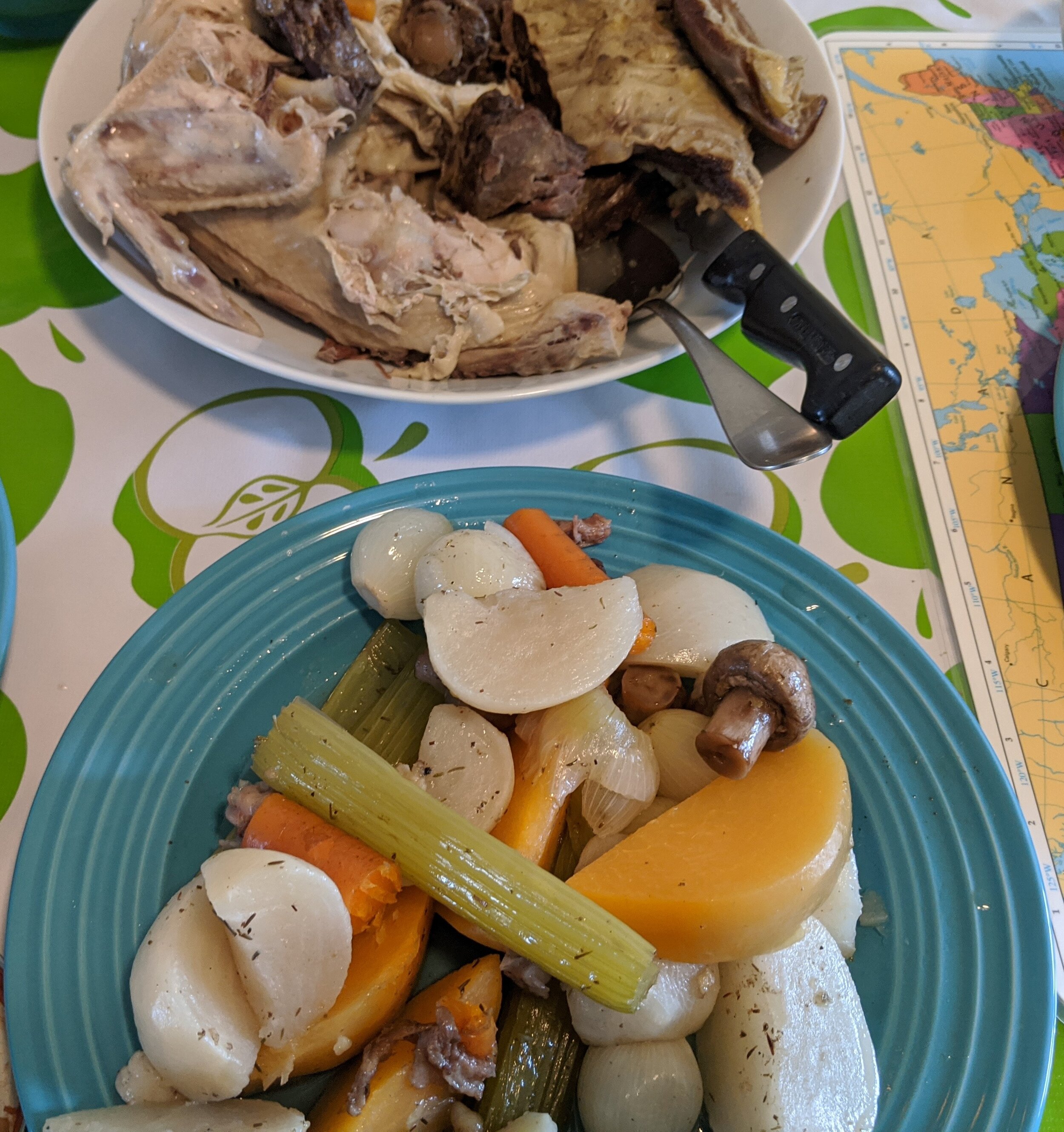
IMG_20200315_170456.jpg

Grey!

Tasteless!

Boring!

None of the above!

If this were called “Simmered in a Bone Broth with Multiple Layers of Flavor Dinner” nobody would remember the name, but we would all remember how good it tastes.

You can play around with variations within the theme of the basic components; here is how we made it. 4-year-old approved.

Pigs feet (cleaned and split) - or some other cartaliginous, flavorful pork cut. There might be a few small hairs left on your pigs feet: take a carmelizing torch or lighter or other flame source and burn those off.

Oxtail - or some other cartaliginous, flavorful beef cut (or perhaps mutton).

We added in beef short ribs as well.

If not using pigs feet or a lot of oxtail, consider adding chicken feet or some marrow bones. The goal is a rich, gelatinous bone broth.

For extra flavor, sear or roast the meats and bones to brown them before boiling.

Place in a large pot, cover with water, bring to a rolling boil.

Turn down the heat to a simmer, so that the water steams and bubbles are just barely coming to the surface. Skim off most of the gunk that came to the top after bringing it to a boil. There’s nothing bad about this stuff, but it forms a layer on top of the broth that interferes with proper cooking.

Keep slowly simmering and check back tomorrow and see if the meat is falling off the bones yet.

Remove the oxtail and shortribs and set aside, then carefully strain the very hot broth. Most of the pig’s feet will have fallen apart and dissolved into the broth, so feel free to pick out any larger pieces of meat that are left and then throw out the bones.

To the broth add back the short ribs, oxtail, and trotter meat, then add:

Salt to taste and whatever herbs you like

Whatever amounts you like of celery, mushrooms, pearl onions, and root vegetables (carrots, turnips, parsnips, rutabega)

and one Whole Chicken

Continue simmering until the chicken is fully cooked.

Serve by removing the meats and vegetables from the broth, then serve the broth on the side.

Preserving eggs

WARNING: Never ever preserve farm fresh eggs. Never store eggs outside the refrigerator. You will automatically die. Nobody has ever preserved eggs before without refrigeration and lived to write detailed accounts of how to do it which you can find online.

Hypothetically speaking, in a popular computer simulation game, around this time of year our laying hens start to lay more eggs.

Like, a lot more eggs.

In the future we plan to pass some of those on to our CSA members, but we like to provide fresh eggs to our customers so we don’t like to save up eggs for weeks between CSA drops. Our farm fresh eggs do keep extremely well, in part because we never wash them until we are ready to use them, which keeps their natural protective coating on them. Our farm is a mile off the main road so we can’t really sell them at a roadside stand, and we don’t have access to any markets right now to sell our eggs.

Come summertime we always sell out of all the eggs our layers produce, so it’s nice to have a stockpile for the family so we don’t have to take them out of potential sales. Likewise at the end of the summer it’s nice to put some eggs by so that we have eggs during the winter. Our hens do still produce during the winter, but sometimes it’s not enough.

The two ways we have (in a computer simulation) tried preserving eggs have both worked, but one worked better than the other.

Freezing works really well

Freezing egg yolks is kind of difficult and makes them strange, so what we do is scramble a whole mess of uncooked eggs and then pour the mixture into muffin tins. Then we freeze them. After they are completely frozen we pop out the egg-pucks using a butter knife and store them in a zip-top bag in the freezer. Each tin holds the equivalent of about 3 eggs (depending on how big the eggs are) which, when defrosted, is the perfect size for an omelette.

This method would work better if we had a silicone muffin…not-tin, but whatever one calls a muffin tin made out of silicone. It’s a little difficult to get the frozen egg-pucks out of our metal muffin tins, and a little messy because we generally have to slightly melt the bottom by putting it on a hot stove or (carefully) turning it upside-down under hot water, and then using a butter knife to pry out the frozen eggs. Of course an ice-cube tray would work as well as a muffin tin, but egg-cubes are a less efficient use of space. And, as mentioned, the amount of scrambled egg mixture that fits in each muffin-tin cup is a good portion.

Slaked lime works also

Preserving eggs in lime-water prevents air (and thus bacteria) from getting into the shells. This is lime as in calcium hydroxide, not the fruit. You know, calcium - the same stuff the egg shell is made out of? The calcium hydroxide covers the eggs and fills in the tiny pores in the egg shell, making it completely airtight. It’s extremely important to use food-grade lime, such as is sold for making some kinds of pickles, and not lime sold at a building materials and hardware store. Eating the industrial-grade stuff would be a very bad idea. Your computer simulation game would likely end with a game over.

We mixed the food-grade calcium hydroxide with boiling water and let it cool, then carefully put the eggs into it. We filled a 2 gallon bucket with eggs and covered them completely with the limewater, then an air-tight lid. In strong concentrations calcium hydroxide causes chemical burns. One doesn’t use that strong a concentration just to preserve eggs, but it still feels weird on your skin and it may be best to wear gloves.

Then we put a lid on the bucket and left it for five months.

This method worked…but this was during the hottest part of the summer, and we don’t have a real root cellar, so while the bucket full of limewater eggs wasn’t boiling in the summer sun, it still sat at temperatures well over seventy degrees. The method did preserve the eggs: they were not rotten at all and the yolks were still nicely yellow. However, the yolks had degraded and become somewhat gelatinous in texture, and just kind of fell apart when cracked open. Had these been the only eggs we had, we would have eaten them, but since we had bags full of frozen eggs available we fed the limewater eggs to our pigs, who loved them. Stored in a cooler environment this method would have worked great, and it has the benefit of preserving the whole egg, unscrambled.

New video on Youtube

Just some video of the sheep eating grass while I ramble on.

I was thinking that our competition really comes from the big, corporate, international “so-called-organic” grocery stores. The “free range” chicken that is $4.99 a pound after being trucked across half the country, sold with million-dollar marketing campaigns, stocked on retail shelves in storefronts with million-dollar leases, with huge management staffs, expensive but individually-underpaid retail labor, high-priced corporate attorneys, well-funded lobbyists…

In other words, fakes! All that extra overhead cost and yet they manage to sell a “free range” chicken! Of course these big business chickens are not free range in any sense that small, conscientious family farms are raising chickens.

We think the more local, sustainable farms the better. Small farmers have more flexibility to adopt sustainable practices. Smaller, local stores can sometimes stock great products at reasonable prices because they buy locally instead of shipping food around the world. And shoppers who want better, sustainably-raised food have much more influence with a local farmer or a locally-run store they can actually go visit and talk to face to face.